
Introduction
Suppose you have a business and would like to promote it with online advertising. You’ve resolved to try paid marketing, but you have one nagging question:
Should you invest in Google Ads or Meta Ads?
Both marketing platforms are powerful advertising platforms, but they are different and intended for different marketing use cases.
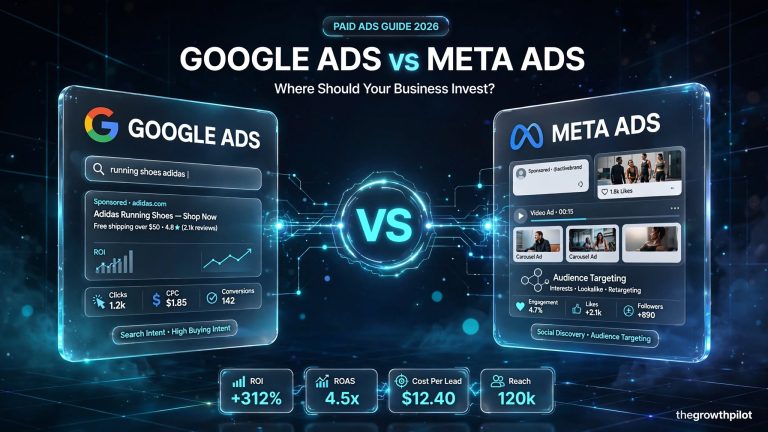
Google Ads is designed to target those actively searching for your product/service. Meta Ads is designed to bring your product/service in front of people when they’re simply scrolling through Facebook and Instagram.
For instance, a person looking for “digital marketing agency near me” could have an urgent need and may be ready to get in touch with a provider. At the same time, a person scrolling on Instagram may stumble upon a digital marketing agency on an ad.
Both can produce a prospect. But one has a different mental attitude.
So, Google Ads VS Meta Ads: Where should your business spend?
In this guide, we will compare the two advertising platforms, break down the cost, targeting, pros and cons, lead generation, ROI and show you which advertising platform is right for startups, small business, ecommerce brands and large companies.
Let’s explore.
Google Ads vs. Meta Ads – Which One Is Better?
Meta Ads usually generates more efficient results in the realm of increasing interest, creating awareness, and finding new audiences while Google Ads are a superior choice when it comes to capturing the attention of buyers who are actively shopping for a specific item.
No platform is better than the other. Which is best for you depends on your objectives, your audience, buying behaviour, your ideal customer journey and your advertising budget.
Go with Google Ads when people are looking for what you’ve got to offer.
Choose Meta Ads if you’re reaching out to new audiences with your products or services.
Select both if it is necessary to create awareness, grow demand, tap into demand that already exists and re-target potential customers.
1. What Are Google Ads?
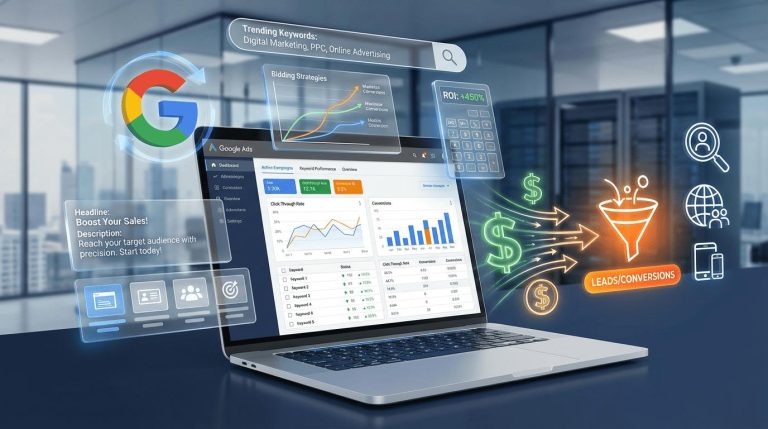
Google Ads is an online advertising platform developed by Google where advertisers can run ads across Google products.
You can develop ads to show up when consumers are searching for products, services or information that you provide.
For example, imagine someone searches for:
Best SEO agency for small businesses.
Website development company near me.
Buy running shoes online.
Affordable digital marketing services.
A valid Google Search ad will likely be displayed as one of the search results.
And this gives an opportunity for businesses to reach out to possible customers that are actively searching.
There are also other options for other ad types where you can show your ads. With Google Ads search ads can be displayed and depending on the campaign type, you also have the possibility to show your ads on YouTube, Google Display Network, Google Shopping, Maps, Gmail and other placements of Google.
How Does Google Ads Work?
The way Google Ads works is by utilizing an advertising auction.
ADVERTISERS pick a campaign objective, then design ads, target audiences and choose bidding strategies.
Google calculates eligible ads using its auction when a relevant search is performed or an eligible ad placement is accessed.
Several factors influence ad placement, including:
Your bidding strategy.
Ad and landing page quality.
Competition.
Search context.
Expected impact of ad assets.
Example:
Let us say for example that you own a website designing company in India.
You set up a Google Search campaign for searches including: “website development company”, “professional website designer”, and other related keywords.
Your ad can also show up in the search results when a user searches for a product or service you offer.
If the prospect clicks your ad through to your landing page and completes a form, they have become a potential prospect for you.
Different Types of Google Ads Campaigns
1. Google Search Ads
Google Search anuncios that are shown on Google Search results when users make a search.
Great for: Service businesses, lead generation, and local searches with high intent.
2. Google Display Ads
Text advertisements that may run on any screen or application in the Google Display Network that is suitable.
Best for: Brand awareness, remarketing and audiences.
3. Google Shopping Ads
Product-oriented ads which display pictures of the product, price, and merchant information.
Best for: Ecommerce businesses and online product stores.
4. YouTube Ads
Video ads delivered via YouTube and relevant video inventory.
Who it’s for: Brand awareness, product showcases, stories, and audience engagement.
5. Performance Max Campaigns
Does Google’s ad inventory and automation help to reach customers with goal-oriented campaigns?
Best for: Companies wishing to maximize campaigns based on sales or lead creation objectives.
6. App Campaigns
Marketing efforts aimed at increasing adoption of a mobile app or to encourage app installation or in-application actions.
Ideal for: Application creators, mobile enterprises, as well as application-based solutions.
Advantages of Google Ads
Addresses consumers who are actively seeking for the product /service.
Supports keyword-based advertising strategies.
Offeres several campaign types in order to target certain goals.
Assists with increasing traffic, enquiries, calls and sales to your website.
Offers location-based targeting options.
Provides conversion measurement and campaign performance data.
Enables companies to change budgets and bidding strategies.
Drawbacks of Google Ads
Competitive keywords can become expensive.
Poor keyword selection can attract irrelevant traffic.
Campaigns require proper optimization and monitoring.
Results vary depending on the quality of the landing page and the conversion process.
There could be a lack of search demand for new and unfamiliar products.

2. What Are Meta Ads?
Meta Ads is an advertising platform built by Meta that businesses can use to promote products and services on Facebook, Instagram, and other Meta placements that are eligible.
Compared to search advertising, Meta Ads are more of a customer audience targeting: they improve how businesses find users based on demographic data, interests, behaviours and whatever signals they have to offer.
Rather than waiting for someone to search for your product you can now introduce your business to people who might be interested in what you have.
Now say you’re running a fashion apparel company.
Design appealing product advertisements of your newest collection, and direct them to the appropriate audiences on Instagram and Facebook.
A non-actively searching individual could see your product, engage with your website, follow your account, or even buy from you.
How Do Meta Ads Work?
Can put together advertising campaigns by selecting a target with specific marketing objectives in mind.
Advertiser sets objective, targeting, creates a piece of creative, and set a budget and publish.
Using the signals that are available about an audience and a campaign, Meta’s advertising system shows ads to people who are most likely to perform the requested action.
Your ads can be shown in:
Facebook Feed.
Instagram Feed.
Instagram Stories.
Instagram Reels.
Facebook Stories.
Facebook Reels.
Other eligible Meta placements.
Example:
Suppose you operate an online footwear store.
You develop an ad campaign on Instagram, promoting your newest shoes and reach audiences who might be into fashion, shoes, and online shopping.
People who are visiting Instagram may come across your collection, tap on your advert, go to your website, and make a purchase.
Here’s how Meta Ads can help your business make them aware, and get them the right audience.
Important Types of Meta Ads
1. Image Ads
Single-image advertisements that feature products, services, offers, or a brand message.
Ideal for: to show off, deals & discounts, and brand building
2. Video Ads
That delivers product benefits, how-to demonstrations and brand stories.
Best for: Engagement, storytelling, and product demonstrations.
3. Carousel Ads
Slick set of ads promoting multiple cards that you can swipe through.
Best for: Product collection; Diverse services and to show off various features.
4. Stories Ads
Vertical ads that appear in Facebook and Instagram Stories.
Reasons to use it: Promotions, flash sales, and mobile-centric advertising.
5. Reels Ads
Short-form video ads are available in eligible Reels placements.
Who it’s best for: Brand discovery, aesthetic appeal and product impression.
6. Lead Generation Ads
Campaigns created to gather data from a potential customer through supported lead forms or other conversion destinations.
Ideal for: Real estate, consultancy services, education, and B2B enquiries.
7. Retargeting Ads
Advertisements to re-engage with eligible people who have previously engaged with your business, website, or content.
Ideal for: Nurturing prospects, boosting sales, and driving repeat purchases.
Advantages of Meta Ads
Helps businesses reach new audiences.
Offers audience and interest-based targeting options.
Supports visually engaging advertisements.
Provides multiple creative formats.
Assists in the conversion of leads, traffic and sales on the internet.
Supports retargeting strategies.
Suitable for brand awareness and product discovery.
Provides campaign performance and conversion measurement tools.
Drawbacks of Meta Ads
Users may not have immediate purchase intent.
You need compelling creatives.
Advertisements compete with regular social media content.
Audiences and creative fatigue can cause a drop in campaign performance.
Tracking and attribution may require additional configuration.
Businesses need consistent creative testing and optimization.
4. Google Ads vs Meta Ads: Which Is More Cost-Effective?
The cost is one of the most critical considerations businesses make before choosing an advertising platform.
There is no definitive response to which platform is cheaper.
The real cost of advertising is going to depend on:
Industry competition.
Target audience.
Location.
Keyword demand.
Campaign objective.
Ad quality and relevance.
Creative performance.
Bidding strategy.
Conversion rates.
Google Ads Cost
Google Search campaigns tend to be set up for bidding per click (CPC), but there are other bidding strategies and goals available in Google Ads.
Depending on your campaign and bidding type you can be charged for clicks, impressions, conversions or any other qualified advertising interaction.
For instance, a business who targets highly competitive keywords may have a much higher cost per click than a business who targets a less competitive niche.
Meta Ads Cost
Meta Ads offers various campaign goals and bidding strategies.
The cost can be calculated by: (depending on the type of campaign).
Cost per click (CPC).
Cost per thousand impressions (CPM).
Cost per lead (CPL).
Cost per purchase.
Cost per conversion.
For instance, an ecommerce company might advertise their merchandise on Instagram Reels using Meta Ads and track the expense of conversions.
Which Platform Is Cheaper?
Meta Ads can be very low, or a higher click cost from Google Ads may be worth it if it means customers with greater intent to buy are coming in.
But cheaper clicks do not necessarily equate to more profitable campaigns.
In terms of advertising costs, the optimal comparison is not how much it costs to get a click. Rather, it’s to measure the cost to win a qualified customer.
5. Google Ads vs Meta Ads: Which Generates Better Leads?
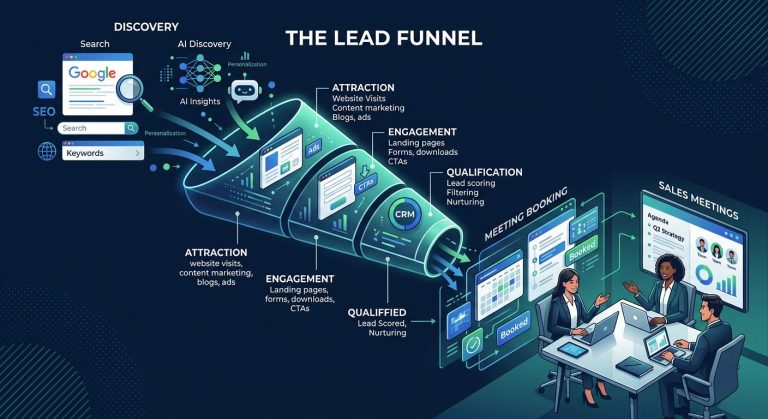
Both can provide leads of high quality but the level of quality and qualification that your leads are at really depends on your business model, offer, their setup and your customer journey.
Google Ads for Lead Generation
Google Ads could be an ideal platform for when potential customers have the intention of discovering your service.
For example:
Best digital marketing agency.
Website development services.
SEO company near me.
Interior designer in Lucknow.
Commercial property consultant.
These searches can indicate an existing requirement.
What advertisers can do: direct the traffic to a dedicated landing page that would contain information about the services, a contact form, a contact number and a call-to-action button.
Meta Ads for Lead Generation
Meta Ads is effective at targeting potential customers who are likely to buy a product or service but haven’t yet sought it out.
For example:
Real estate project promotions.
Coaching institute admissions.
Fashion product promotions.
Beauty and wellness services.
Online consultation offers.
Enquiries can be gathered using lead forms, messaging campaigns, and website conversion campaigns.
Which One Produces Better Leads?
Google Search Ads work well for demand-based enquiries, and Meta Ads can work well for reaching larger relevant audiences to generate interest.
The true quality of the leads will be determined by the offer, campaign targeting and messaging, sales questions asked on the form, and the sales process follow-up.
6. Google Ads vs Meta Ads: Which Is Better for Different Businesses?
You can’t find one advertising approach that will work effectively in all industries.
Here’s a look at what platform might work better for you based on your type of business.
1. Local Businesses
Examples:
Restaurants.
Dental clinics.
Salons.
Home repair services.
Local service providers.
Suggested initial goal: Google Ads
Local customers frequently look for a closer option.
Relevant Google Search campaigns can help you reach people looking for your services in specific locations.
Meta Ads can help round out this strategy with local awareness campaigns, offers, and retargeting.
2. Ecommerce Businesses
Examples:
Fashion stores.
Footwear brands.
Beauty products.
Electronics.
Home decor.
Starting point of sale for retail customers: It varies by product demand and shopping pattern.
Target customers searching for your products with Search and Shopping campaigns.
Meta Ads with engaging images, videos, carousel ads to help promote the products.
For many ecommerce brands, utilizing both can help with product discovery, purchase intent and retargeting.
3. B2B Businesses
Examples:
Software companies.
IT service providers.
Digital marketing agencies.
Business consultants.
Industrial suppliers.
Suggested entry point: Google Ads-Existing search demand.
B2B purchasing – deals are often researched in advance of a sales call.
Google Ads can steer relevant searches, where Meta Ads can help the branding, remarketing, audience engagement, and other types of campaigns.
But it might also be LinkedIn if the job role is a key target.
4. Educational Institutions
Examples:
Coaching institutes.
Online courses.
Training centres.
Skill development programmes.
Recommended starting point: Both platforms.
Google Ads may be the key to directly targeting students and their families who are actively seeking particular courses or establishments.
Meta Ads can be used to target audiences with content related to admissions, scholarships, education and upcoming batches.
5. Fashion and Lifestyle Brands
Examples:
Clothing brands.
Jewellery stores.
Footwear businesses.
Accessories.
Lifestyle products.
Suggested first campaign: Meta Ads for product discovery.
Instagram and Facebook give brands the power to communicate their product offerings via images, videos, Reels, and carousel ads.
Google Shopping and Search campaigns can reach people that are actively searching for products.
6. New Businesses And Startups
If the buyer is already familiar with the product.
If your prospects are already searching for what you offer, Google Ads can meet that existing demand.
. If it’s a new product that requires an explanation, Meta Ads can help build awareness.
Begin with one distinct campaign goal, and add-on once results are verified.
7. Google Ads vs Meta Ads Which Is Better for Small Businesses?
It is important to choose the right place for advertising to avoid wastage as most small businesses have limited budget.
It all depends on how your customers find out about you and buy from you.
Choose Google Ads if:
People actively search for your services.
Your business solves an immediate problem.
You want to attract high-intent search traffic.
You offer location-based services.
Your website has dedicated conversion-focused landing pages.
Choose Meta Ads if:
You’re looking to reach new audiences with your brand.
Your products are visually attractive.
Your business depends on social discovery.
You have engaging photos and videos.
You are looking to encourage offers and create a brand awareness.
Example: A Small Digital Marketing Agency
Suppose a digital marketing agency has the goal of attracting small business enquiries.
It can use Google Ads to market services such as SEO marketing, Google Ads management, and social media marketing.
Meanwhile, it can highlight client achievements, sales strategies, benefits of your service, and success stories with Meta Ads.
This method allows the agency to engage clients at various steps in the sales funnel.
8. Can You Run Google Ads and Meta Ads Together?
Yes. The combination of Meta Ads and Google Ads can form a well-rounded digital advertising strategy if both campaigns serve distinct purposes and have adequate budgets.
Rather than viewing these platforms as rivals, companies could utilise them to facilitate various steps of the customer journey.
How Both Platforms, work together
Stage 1: Meta Ads to Build Brand Awareness
Reach new audiences by introducing your business with images, videos, Reels and helpful content.
Stage 2: Customer Interest
Prompt visitors to your site, ratepayers to come, search your services, or get details about what you have to give.
Stage 3: Search Demand Capture Using Google Ads
When people relevant to your business search for your brand, services or related solutions, appropriate Google campaigns can put you front and centre.
Stage 4: Retarget Interested Audiences
Reconnect with people who have already interacted with you, using the remarketing audiences you can select if they are eligible and conversion tracking.
Stage 5: Conversion and Optimization
Measure leads, purchase, revenue and customer acquisition costs so that you can figure out which campaigns are the ones that are growing your business.
Example of an integrated advertising approach
Imagine you operate an online clothing store.
Use Meta Ads to launch your new clothing collection.
Encourage interested users to visit your website.
Take advantage of Google Shopping and Search campaigns.
Send retargeted ads to all qualified website visitors.
Examine buying and sales data to optimize your campaigns.
It is an interesting approach as it helps combine purchase intent with product discovery.

Key Metrics to Track Google Ads and Meta Ads Performance
Creating ads is just one aspect of a digital marketing campaign. Measuring the results of your advertisements’ performance is just as crucial.
Here’s what metrics you should be watching for your business.
1. Click-Through Rate (CTR)
CTR The percentage of people that come across your result and click on it.
Formula:
CTR = (Total Clicks / Total Impressions) × 100
2. Cost Per Click (CPC)
CPC is the average amount you pay for each click.
Formula:
CPC = Total Advertising Cost / Total Clicks
3. Cost Per Lead (CPL)
CPL stands for cost per lead and shows how much you spend in order to generate a lead.
Formula:
Cpl = total ad spend total leads
4. Conversion Rate
Conversion rate is the proportion of visitors or ad clicks that leads to a successful conversion, according to your reporting definition.
Formula:
Conversion Rate = (Total Conversions/Total Relevant Visits) x 100
5. Return on Ad Spend (ROAS)
ROAS is the amount of revenue that can be attributed to advertising and compares it to the advertising cost.
Formula:
ROAS = Attributed Revenue / Advertising Cost
For example, if your business has ₹ 10,000 of advertising and ₹ 50,000 of attributed revenue:
ROAS = Rs. 50,000 / Rs. 10,000 = 5
So the campaign delivered ₹5 of attributed revenue for every ₹1 spent on advertising.
Keep in mind that your ROAS is not your profit. You’ll need to calculate the product costs, wages, agency fee, shipping, taxes, and any other expenses.
6. Cost to Acquire a Customer (CAC)
CAC is a total of the costs you spend to acquire a new customer.
Formula:
CAC = Total Acquisition Costs / Number of New Customers Acquired
By measuring these metrics the companies can determine the platform which is more effective for their business.
11. Common Advertising Mistakes Businesses Should Avoid
Advertising channels even extremely powerful platforms can also be money pit if not managed properly.
Here are some common mistakes to avoid.
1. Running Ads with No Clear Purpose
Each campaign should have a goal like generating leads, driving purchases or creating awareness.
2. Choosing the Incorrect Segment
Off-topic keywords and irrelevant audiences generate visitors who don’t have the potential to become customers.
3. Ignoring Landing Page Quality
Even the best-advertised advertisement will not be able to make up for your website’s poorly-conceived landing page.
4. Do Not Track Conversions
Without the proper conversion tracking in place, it can be hard to tell which campaigns really work.
5. Repeating the Same Creative With All Audiences
Various messages, images, offers, and ad formats may appeal to various audiences.
6. Ending Campaigns Prematurely
Campaigns require adequate time and accurate data for proper analysis. Do not rely on a small number of clicks or a single day of performance.
7. Looking at Only Clicks
People are interested in clicks and impressions, but sales and income are more important.
12. How to Choose the Right Advertising Platform for Your Business
Investing in Google Ads or Meta Ads.
Question 1: Is anyone looking for what you’re selling?
However, if you answered yes to any of these, then Google Ads could be a good place to start.
Q2. Is a visual sales promotion needed?
If yes, we can use Meta Ads to feature your product in photos/videos.
Question 3 – Immediate enquiries or long-term brand awareness?
Google Search Ads, and Meta Ads can increase awareness and demand.
Q4. Do you have a website that can be converted?
Before you increase your ad spend, ensure your landing pages, contact forms, checkout flow and tracking are all in place.
Question 5: Can you measure actual business results?
Don’t just measure engagement. Monitor details on qualified leads, purchases, customer acquisition costs, and revenue.
Once you respond to these inquiries, you will be prepared to identify a marketing plan that matches your business objectives.
13. Why Choose thegrowthpilot for Google Ads and Meta Ads Management?
Identifying the ideal platform is a start, strategic campaign management is what makes a business turn advertising dollars into real opportunities.
At thegrowthpilot, we believe what makes digital advertising effective is your business, your target customer, your competitors and your growth goals.
Our advertising is aimed at delivering the right message to the right people at the right time.
Our Google Ads Services
Google Search Ads Management.
Google Display Advertising.
Google Shopping Campaigns.
YouTube Advertising.
Keyword Research and Optimization.
Conversion Tracking.
Campaign Monitoring and Reporting.
Meta Ads Services We Provide
Facebook Ads Management.
Instagram Ads Management.
Lead Generation Campaigns.
Ecommerce Advertising.
Creative Strategy and Ad Testing.
Retargeting Campaigns.
Campaign Performance Analysis.
Process of Advertising
1. Find: Learn what you have, who you need, and what you want to do.
2. Plan: Create the right advertising plan for your budget and customer journey.
3. Action: Develop and implement suitable advertising campaigns.
4. Optimize: Review performance, identify areas for improvement in targeting, creatives and conversion opportunities.
5. Expand: Take advantage of campaign learning to seize opportunities for sustainable business expansion.
Use thegrowthpilot to create a paid advertising plan matching your business objectives whether you would like to generate more leads, increase online sales or raise brand awareness.
Conclusion: Google Ads or Meta Ads – Where Should Your Business Invest?
Choosing between Google Ads and Meta Ads should not be a matter of which one has more users or who can sell you cheaper clicks.
It should be driven by your customers, your product or service, and your marketing goals.
Google Ads can be an effective solution for brands looking to reach customers when they are actively seeking a product or service. Meta Ads can be an effective solution for brands looking to build awareness, generate interest and engage a new audience.
Blending the two platforms can, in a lot of cases, become a more robust advertising approach for plenty of businesses.
When people search – Google Ads When people haven’t yet searched – Meta Ads The most profitable business growth is the one that can be measured!
Ready to grow your business with smarter advertising?
Work with thegrowthpilot and convert advertising into converted business opportunities.
FAQs ( frequently asked questions )
1. Is Google Ads superior to Meta Ads?
In most cases, Google Ads does a great job at pulling in existing demand while Meta Ads does a great job at discovering new potential audiences, branding, and visually focused promotions.
2. Are Meta Ads cheaper than Google Ads?
Sometimes; advertising expenditures can vary based on factors such as competition, target demographics, campaign goals, quality of the creative content, and conversion results.
3. What platform is best for generating leads?
Google Ads can draw the search enquiries of high intent, while Meta Ads will get the leads via Audience targeting, lead forms & messaging campaigns.
4. Is Google Ads good for small businesses?
Yes. Google Ads can allow small businesses to get in front of people who are searching and looking for their business.
5. Are Facebook Ads and Meta Ads the same?
Facebook ads are included within Meta Ads, along with ads on Instagram and other eligible Meta placements.
6. Can I run Google Ads and Meta Ads together?
Can I run a Meta Ads campaign for audience discovery and a Google Ads campaign for searches within the same marketing strategy? Yes.
7. Which platform is right for ecommerce?
Both are effective: Google Shopping and Search campaigns take in the demand for your products. Meta Ads visual discovery and retargeting helps a lot.
8. Do Google Ads guarantee sales?
No, Google Ads cannot ensure sales; they will all depend on demand, competition, targeting, landing pages, price, and customer experience.
9. How much should a small business spend on advertising?
For small businesses, determine a reasonable test budget based on how many customers you want to acquire and your margin, industry competitive pressure, and cost of acquisition.
10. Which is more profitable advertising platform?
No platform has been shown to produce a more profitable ROI; the more profitable platform is determined by campaign performance, customer value, conversion rate, and total acquisition costs.
11. Should startups run Google Ads or Meta Ads first?
Use Google Ads when people are searching for what you do, and Meta Ads to increase visibility or launch a new product.
12. How long does it take to see results from paid advertising?
Campaigns may get some early Traffic / enquiries soon after the campaign goes live but it is only when they start to mature that they should be able to measure performance properly.